 |
|
|
|
|
|
|
|
|
|
|

|
|
|||||||||

|

|

|
|
|||||||
 |

|

|
|
|||||||

|

|

|

|

|
|
|||||
|
||||||||||
 |
|

|
|

|
|

|
|

|
|

|
|
|
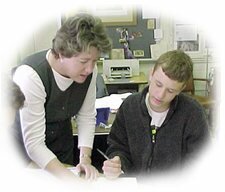 As with many fortuitous events, Lisa Ledwith, pre-calculus teacher at Germantown Academy, Fort Washington, Pennsylvania, says that, she "just fell into teaching" with the Math Trail concept about five years ago. While attending a summer conference for math teachers, Ledwith saw a demonstration of how students could experience math in everyday life while they followed a guided walk known as a Math Trail.
"A Math Trail gets students to see math outside the textbook and outside the classroom." As she tells students, "Math is all around you. As you solve math problems related to your surroundings, 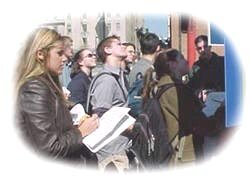 your observation skills improve. You will carefully observe the details and learn to see your surroundings in a different way." That way is very important to Ledwith because students can begin to find real life reasons in their own communities to learn math. By interacting with the math in their world via Math Trail problems, students can then become more successful independent problem solvers and thinkers rather than more traditional "math memorizers. "
How does a Math Trail project work?
Ledwith emphasizes that "each teacher should tailor the project to her or his own interests, resources, and environment." However, all of her Math Trails share some common elements: the teacher designs a series of math problems based on observation of buildings, art, or other objects within a community environment. This environment could be in the surrounding city, at the school, or in the classroom itself. For Ledwith’s current Math Trail activity, this means that students and teachers together go on a daylong field trip to nearby Philadelphia. There the students work on about 10-15 problems. They discuss an approach to each problem, collect data, and begin calculations to find a solution.
Next Page >>>
<<< Current Showcase